


Guiyang.bai@honno-auto. com
86-13840589744


RF admittance level switch with shielding electrode against material build-up; relay DPDT, 24 VDC / 220 VAC, to 800 °C, 2.5 MPa, Ex d IIC T6 option, IP65; liquids, slurry, dust and two-liquid interface.
The HNL50-A RF admittance level switch combines a sensor unit and an electronic unit. The sensor has a measuring probe, shielding electrode and grounding terminal. Material level is reflected by the admittance change between probe and vessel wall; when the material reaches the switch point, the electronics actuate the relay and output a switch signal. The shielding electrode rejects misoperation from material hanging on the probe, so the signal switches only when material truly reaches the set point.
The switch suits liquid and slurry level alarm, interface detection between two liquids, dust and bulk material level, sticky and coating-prone media, highly corrosive liquids and solid particles, chemical storage tanks, oil-water and solvent interface control, water treatment and sewage, food and beverage processing, tanks with agitators, and high-temperature / high-pressure process vessels that need reliable point-level switching without moving parts.
Good fit: liquid and slurry level alarm, interface detection between two liquids, dust and bulk material level, sticky and coating-prone media, highly corrosive liquids and solid particles, chemical storage tanks, oil-water and solvent interface control, water treatment and sewage, food and beverage processing, tanks with agitators, high-temperature and high-pressure process vessels, point level switching without moving parts.
Choose HNL50-A when:
You need a non-contact point-level signal for liquid, slurry, dust, bulk solids or a two-liquid interface, with no moving mechanical parts.
The medium is sticky, coating-prone or bridging-prone, where a simpler capacitive probe can false-alarm on buildup.
Relay DPDT output to a PLC or alarm relay, 24 VDC or 220 VAC supply, matches the control system.
Confirm with us first when: the medium is highly conductive or has heavy coating beyond the shielding range, particle size exceeds 10 mm, the required pressure or temperature exceeds the selected standard / high-pressure / high-temperature version, or an explosion-proof certificate type must be confirmed for the hazardous area.
The shielding electrode prevents false signals from material adhering to the upper probe section; only the active measuring section reacts when material reaches the set point. Medium conductivity and temperature have little effect on the admittance reading, giving high anti-interference stability.
There is no mechanical transmission structure, so the probe is not easily worn and is easy to install. Switch action is reliable with on-site status indication; sensitivity is adjustable. The switch measures highly corrosive liquids and solid particles.
A standard type and a split high-temperature type are offered; the high-temperature split model reaches 800 °C at atmospheric pressure, and a high-pressure version is available for elevated pressure service.
| Model | HNL50-A — RF admittance level switch |
|---|---|
| Measurement medium | Liquid, slurry, dust, material level, boundary between two liquids |
| Repeatability | <1 mm conductive medium; <10 mm insulating medium |
| Response time | 0.2 s when covered by medium; adjustable 0.2…60 s |
| Max switching frequency | 150 times/min; 1 switch point |
| Permissible pressure | Standard: –0.1…2.5 MPa; high-pressure type: 25 °C / 5 MPa |
| Medium density | >0.5 g/cm³; measured solid particles <10 mm diameter |
| Service life | >1 million cycles |
| Signal output | Relay (DPDT), contact current 5 A |
| Supply voltage | 24 VDC / 220 VAC |
| Operating temperature | Standard: –20…180 °C; high-temperature split model: 800 °C / normal pressure |
| Transport / storage | –40…80 °C |
| Vibration / shock | Sine 20 g, 25 Hz–2 kHz (IEC 68-2-6); piston 4.4 g, 25–200 (IEC 60068-2-27); impact 50 g/6 ms; free fall 1 m |
| Protection level | IP65 (IEC 529) |
| Electrical connection | Terminal blocks |
| Mechanical connection | Threaded, flange or clamp |
| Wetted parts / casing | 304 / 316 wetted parts; aluminum casing; weight 3.5 kg |
| Type | Specification |
|---|---|
| Thread | G3/4, G1, NPT3/4, NPT1 (external thread) |
| Clamp | 1-½" = Ø50.5 mm; 2" = Ø64.0 mm |
| Flange | 2", 3", 4" 150 LB / 300 LB; DN50 / DN80 / DN100 at PN2.5 / PN40 |
| Code segment | Code | Description |
|---|---|---|
| Product type | 00 | Standard (integrated) |
| 01 | Split type | |
| Pressure reference | A | Voltage resistance –0.1…2.5 MPa |
| B | Pressure resistance 25 °C / 5 MPa | |
| Measuring range | 10–19 / X | 0–250 / 300 / 350 / 400 / 500 / 1000 / 1500 / 2000 / 2500 / 3000 mm; X = special custom range |
| Supply voltage | A | 24 VDC |
| B | 220 VAC | |
| Signal output | 1 | Relay output, terminal wiring |
| Process connection | A01–A10 / X | G3/4, G1, NPT3/4, NPT1, clamp 1-½", clamp 2", flange DN50, DN80, 2", 3"; X special |
| Temperature range | 1 | Standard –20…180 °C |
| 2 | High-temperature type 800 °C | |
| Explosion-proof | 1 | Non-explosion-proof |
| 2 | Intrinsic-safety explosion-proof type |
Aluminum housing with terminal compartment and side gland, threaded stainless fitting with insulation section and slender probe; flange or clamp alternatives. Probe length matches the selected range; the split version separates the electronics from the probe.
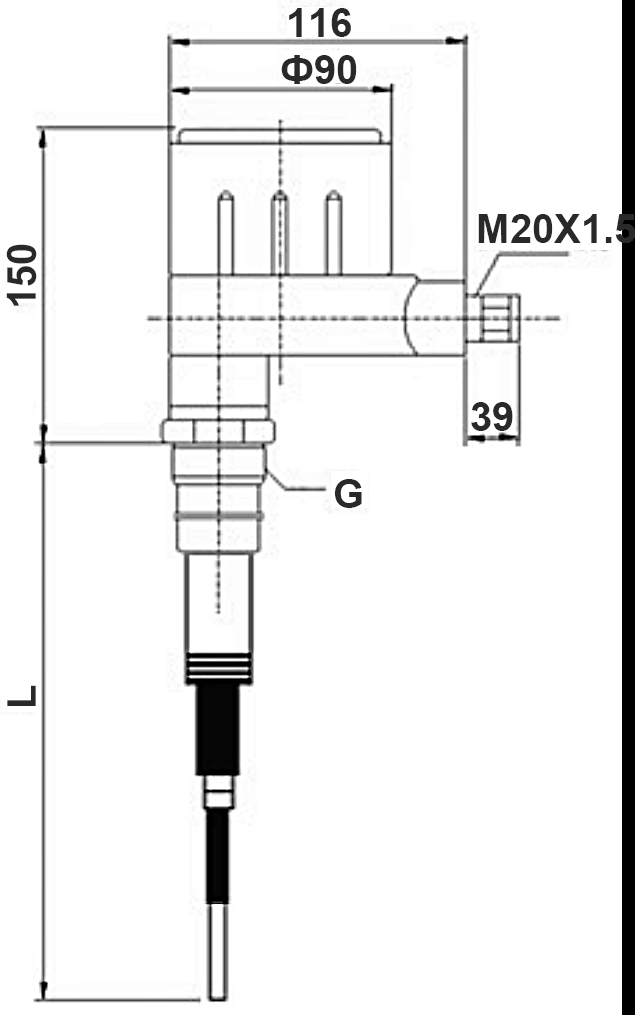
Mount so the active probe section sits in the level path, clear of the vessel wall, agitator, heating element and inlet stream. Keep spacing between probe and wall to avoid capacitance interference; in coating service, confirm the shielding section covers the buildup zone. Wire the DPDT relay per the fail-safe logic required for pump dry-run or overflow protection. Set sensitivity and response time after commissioning with the actual medium.
Chemical storage: corrosive liquid and slurry point-level alarm and control.
Interface control: oil-water, solvent-water and two-liquid boundary detection.
Water and wastewater: sewage, dosing and sludge level switching.
Food and beverage, dust and solids: coating-prone media, dust and bulk material level; high-temperature / high-pressure process vessels.
Send: medium and conductivity, whether conductive or insulating, density and particle size, temperature and pressure, tank material and available opening, required probe length, supply voltage, fail-safe relay logic, and any hazardous-area classification. We will confirm the version, connection and selection code before quoting.
Does probe buildup cause false level alarms?
The shielding electrode rejects signals from material adhering to the upper probe, so sticky or coating buildup does not by itself trip the switch. The relay acts only when the active measuring section is covered; sensitivity and response time are adjustable.
How does the shielding electrode reject sticky coating during point detection?
The shield guards the non-measuring probe section so coating there does not change the admittance seen by the active probe. Only material reaching the active section produces the switch signal, which is the key advantage on sticky, coating or bridging-prone media.
Can it detect slurry interfaces and corrosive liquid levels?
Yes. It handles liquid, slurry, dust, bulk particles and two-liquid interface, with 304/316 wetted parts. Confirm conductivity, density and particle size (particles under 10 mm) against the rated range before ordering.
Which relay state provides fail-safe pump dry-run protection?
The DPDT relay lets you choose NC or NO logic for the safety requirement; define the fail-safe state so loss of supply or signal triggers the desired pump protection or alarm. Match contact current to the load (5 A max).
What probe spacing avoids interference from vessel walls?
Keep the probe clear of the wall, agitator and fittings, and follow the recommended spacing for the vessel geometry. Proximity to conductive walls or fittings can shift the admittance reading; verify the switch on-site with the actual medium.
HNL50-A RF Admittance Level Switch Datasheet (PDF) — view all product manuals on our Download page »
Send us the medium, conductivity, temperature, pressure and opening. We will confirm the version, connection and selection code before we quote.
Send us your application details »
Contact: HongNuo
Phone: 13840589744
Tel: 86-13840589744
Email: Guiyang.bai@honno-auto. com
Add: Zhongguancun Innovation Center, No. 28 Huahai Road, Shenyang Economic and Technological Development Zone, Liaoning Province
We chat
