
Guiyang.bai@honno-auto. com
86-13840589744
One type uses a baffle (or paddle) pushed by the flow; the other uses a heated probe and lets the flow carry heat away.
That one difference decides everything downstream - how fast it reacts, what happens when it gets dirty, and whether the set point can still be changed on site.
We build both. The question buyers actually ask is not which one is better. It is: I already installed one, and it is telling me the wrong thing. Here is how to pick so that does not happen.
Mechanical. A vane, piston or baffle sits in the flow. Water pushes it, a magnet inside moves toward a reed switch, the contact closes. A spring pulls it back when flow stops.
Electronic. A small heated probe carries two temperature sensors. Flow carries heat away, and the difference between the sensors tracks velocity. Past a threshold, the output flips.
Put simply: the mechanical switch has a part in the flow that must move. The electronic one has a part in the flow that must not.
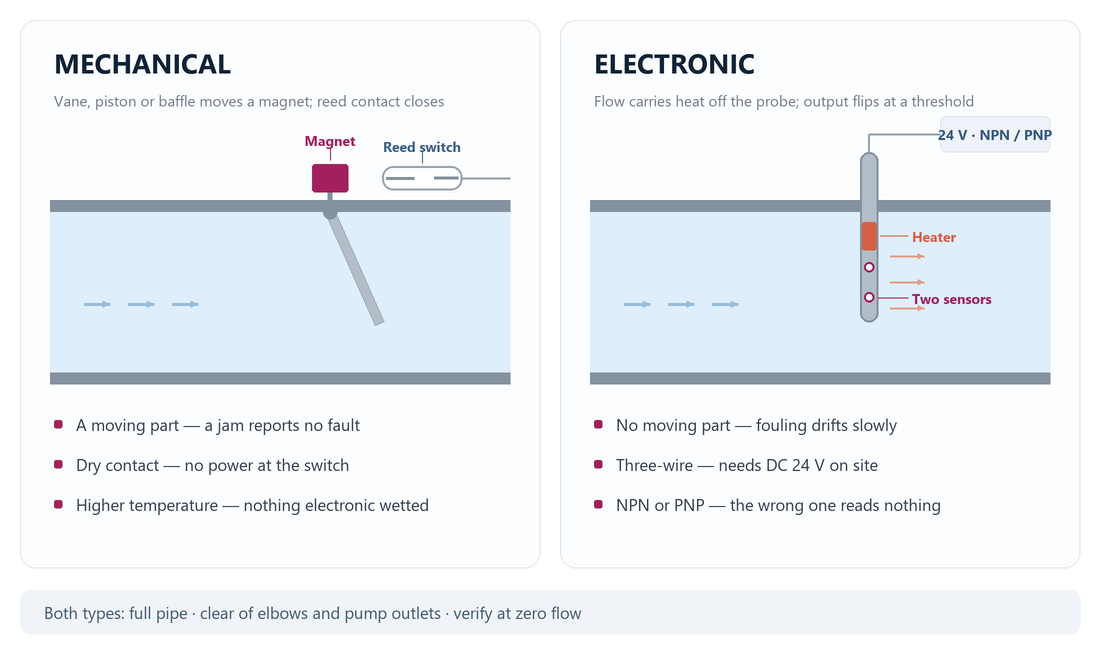
Left: a vane pushes a magnet toward a reed switch. Right: two sensors read the temperature difference across a heated probe.
A mechanical switch that jams does not report a fault. It reports whatever it was doing when it jammed. A vane stuck in the flowing position keeps telling your PLC everything is fine while the pump runs dry.
A fouled probe drifts instead. The trip point goes slightly off, then more off. Annoying - but it warns you first.
That is the real trade: mechanical fails suddenly and quietly. Electronic fails slowly and visibly.
Which is why we do not recommend mechanical for coolant carrying swarf, sewage, or any line with fibres in it.
Is the trip point fixed at the factory, or can it be set on site - and over what range?
Many compact mechanical switches ship with a fixed point. Some have an adjusting screw that changes spring preload, but the scale is not in flow units, so you are adjusting blind.
Electronic switches set the point electronically - repeatable, recordable, and easy to copy onto a replacement. If one switch model has to serve several machine variants at different flow rates, this decides it.
Power at the switch. A mechanical switch needs none - dry contact, potential-free, works with any PLC input. An electronic switch is three-wire: supply, 0 V, output. It needs DC 24 V where it is installed. If the cabinet is 30 m away, that is a cable nobody budgeted for.
NPN or PNP. Choose wrong and the switch works perfectly while the input never sees it. PNP sources from the supply, common on European and Japanese machines; NPN sinks to 0 V.
Above roughly 100 °C, mechanical is usually the only practical option - there are no electronics inside the wetted assembly to cook.
Our HNF10-A is rated -10 to 60 °C at up to 1.6 MPa, 316L probe, 304 housing. That covers cooling water, hydraulic oil and cutting fluid comfortably. It does not cover a 150 °C hot oil line, and no wording in a brochure changes that. Full specifications: HNF10-A electronic flow switch.
| Your line | Pick |
|---|---|
| Coolant, swarf, dirty water | Electronic |
| Pump dry-run protection on a small line | Electronic |
| Trip point may change across product variants | Electronic |
| Hot oil or water above 100 °C | Mechanical |
| Clean fluid, alarm only, no power available | Mechanical |
| Safety chain needs a dry contact | Mechanical |
For the mechanical side of the range, see the piston-type flow switch HNF10-D and the baffle flow switch HNF10-E. For a second electronic option, the HNF10-B electronic flow switch.
- Full pipe. Not the top of a horizontal run on a gravity system.
- Clear of elbows and pump outlets.
- Before the interlock goes into service, confirm the output with the pump off, then confirm the trip with it running.
- Write the trip point on the drawing, so the next replacement can be matched.
Most service calls we get are about air pockets, not failed switches.
Can I swap mechanical for electronic on the same wires?
No. You are going from two wires and a dry contact to three wires and a transistor. Add a supply - and a relay, if the safety chain needs a dry contact.
Does a thermal switch work on oil?
Yes, but set the trip point for oil, not for water. The two carry heat differently, so a water setting will trip late on oil.
Why does it trip while the pump is running?
Air, nine times out of ten. A pocket in the line, a partly closed valve upstream, or a suction leak. Confirm full pipe before replacing anything.
Medium, pipe size, temperature, pressure, and what the control cabinet expects. We will tell you which type fits - and if neither does, we will say so.
Contact: HongNuo
Phone: 13840589744
Tel: 86-13840589744
Email: Guiyang.bai@honno-auto. com
Add: Zhongguancun Innovation Center, No. 28 Huahai Road, Shenyang Economic and Technological Development Zone, Liaoning Province
We chat