


Guiyang.bai@honno-auto. com
86-13840589744


Integrated non-contact infrared temperature sensor, 8–14 μm, 0–1200 °C (default 0–600 °C), 20:1 optics, ±1 %, 150 ms, 4–20 mA / RS485 Modbus, M18×1, 304 stainless steel, IP54.
The HNT50 is an integrated non-contact infrared temperature sensor. The sensor, optical system and electronic circuit are housed in one 304 stainless-steel body. It measures the infrared radiation emitted by a target in the 8–14 μm band and calculates surface temperature without touching the object. The built-in M18×1 thread mounts directly on site; indicators, large-screen displays, paperless recorders, air-blow protection covers, laser sights and adjustable brackets are available as accessories.
Where a contact probe cannot be installed — rotating parts, moving conveyor surfaces, hot or live electrical equipment, fragile or fast-moving targets — the HNT50 reads surface temperature from a distance. Ranges run from 0–100 °C to 0–1200 °C (default 0–600 °C), with a 20:1 optical resolution and 150 ms response. Output is 4–20 mA or RS485 Modbus, for direct connection to displays, recorders, PLCs or DCS.
Good fit: industrial equipment and machinery surfaces, steel and metallurgy (rolling, casting, forging), food processing lines, non-contact measurement of moving or rotating objects, glass, ceramics and paper production, plastic and rubber processing, packaging and printing machinery, high-temperature furnaces and kilns, electrical cabinets and busbar monitoring, conveyor-line surface temperature, plant condition monitoring.
Choose HNT50 when:
The target is moving, rotating, live, fragile, or too hot for a contact probe, and the optical path can be kept unobstructed.
Surface temperature falls within one of the 0–100 … 0–1200 °C ranges; default range 0–600 °C.
You need a 4–20 mA analog loop or RS485 Modbus bus output, with a 2 m cable and M18×1 mounting.
Confirm with us first when: the target is behind glass or smoke that blocks the 8–14 μm band, emissivity is far from the fixed 0.95 value, the target does not fill the 20:1 spot, or the duty is a contact liquid/gas temperature loop (use HNT10 / HNT20 / HNT30 / HNT40).
The distance-to-spot ratio (D:S) is 20:1: at 500 mm distance the measured spot is about 25 mm across. The target must fill the detection head's field of view — keep the measured spot smaller than, or equal to, the target to avoid errors.
Response time is 150 ms (95 %) or 300 ms (95 %); accuracy ±1 % or ±1.5 °C of the reading, whichever is greater. Emissivity is fixed at 0.95, suited to most non-metallic and oxidized surfaces.
N01 4–20 mA two-wire loop, or N02 RS485 Modbus bus. RS485 wiring: brown +10…30 VDC, black GND, yellow 485-A, blue 485-B; 8 data bits, no parity, 1 stop bit, CRC check, baud rate settable (factory default 4800 bit/s).
| Model | HNT50 — Non-contact infrared temperature sensor |
|---|---|
| Measuring ranges | 0–100, 0–150, 0–200, 0–300, 0–400, 0–500, 0–600 (default), 0–800, 0–1000, 0–1200 °C |
| Spectral range | 8–14 μm |
| Optical resolution (D:S) | 20:1 |
| Accuracy | ±1 % or ±1.5 °C of measured value, whichever is greater |
| Emissivity | Fixed 0.95 |
| Response time | 150 ms (95 %) / 300 ms (95 %) |
| Output signal | 4–20 mA (N01) or RS485 Modbus (N02); load ≤ 600 Ω |
| Power supply | 4–20 mA: 10…24 VDC, max 1.2 W; RS485: 10…30 VDC, max 0.12 W |
| Working environment | Transmitter circuit –20…60 °C, 10–95 % RH non-condensing; indicator 0…60 °C |
| Protection rating | IP54 |
| Housing / cable | 304 stainless steel; cable 2 m default |
| Dimensions | 111.8 mm length × Ø18 mm |
| Mounting | Built-in M18×1 thread; adjustable mounting bracket optional; keep optical path unobstructed |
| Ordering code example | HNT50 – N01 / D / S (0–600 °C) |
| Code segment | Code | Description |
|---|---|---|
| Output signal | N01 | 4–20 mA |
| N02 | RS485 (Modbus protocol) | |
| Power supply | D | 10–24 VDC (4–20 mA) / 10–30 VDC (RS485) |
| Temperature range | S | Select one of the listed ranges; default 0–600 °C |
Integrated cylindrical sensor, Ø18 mm body with M18×1 mounting thread and 2 m cable.
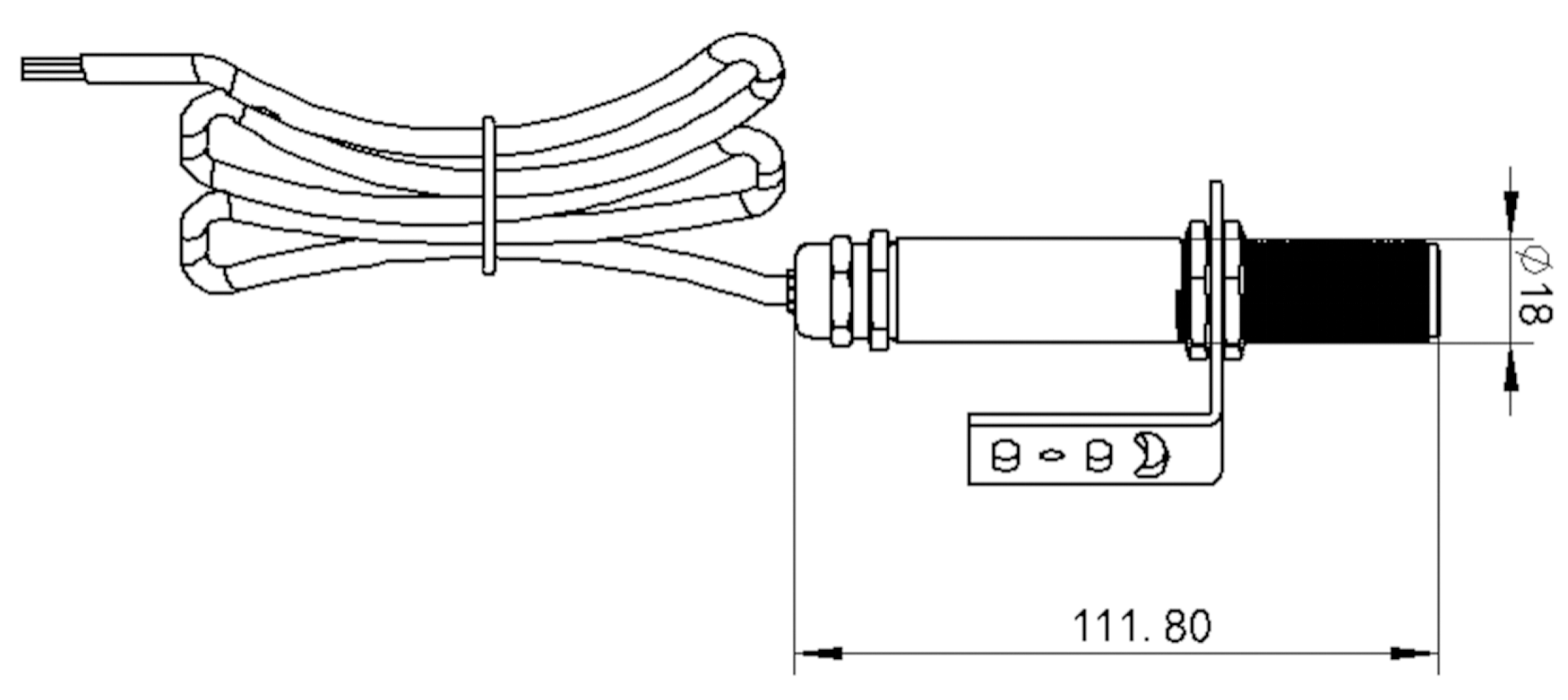

Mount through the M18×1 thread or on the adjustable bracket, and align the head so the target fills the spot; keep the optical path free of dust, smoke and obstructions. Keep the sensor away from motors, generators and high-power cables; add a metal sleeve if needed for EMI protection.
Analog 4–20 mA: brown +24 V, blue signal 4–20 mA+, shield to enclosure or ground (alternate wiring: red +24 V, grey shield).
RS485 Modbus: brown +10…30 VDC, black GND, yellow 485-A, blue 485-B; 8 data bits, no parity, 1 stop, CRC, baud settable (default 4800 bit/s).
Keep the lens clean; wipe dust with lens paper dipped in anhydrous alcohol. For a 0–600 °C / 4–20 mA loop, 600 °C spans 16 mA = 37.5 °C/mA; a 12 mA signal reads 300 °C.
Steel and metallurgy: rolling, casting and forging surface temperature without contact.
Food processing: line and product surface temperature on moving conveyors.
Glass, ceramics, paper, plastic and rubber: hot-line surface monitoring.
Electrical cabinets and busbars: live equipment temperature condition monitoring.
Furnaces and kilns: non-contact surface measurement where probes cannot enter.
Send: target material and surface condition, approximate emissivity, target surface temperature and size, sensor-to-target distance, required output (4–20 mA or RS485), and whether a bracket, laser sight or air-blow cover is needed. We will confirm the range and optics fit before quoting.
What does 20:1 optics mean?
D:S 20:1 is the ratio of measuring distance to spot diameter. At 500 mm distance the spot is about 25 mm across; the spot grows proportionally as distance increases.
How large is the measured spot at 500 mm?
About 25 mm diameter (500 ÷ 20). The target must be at least this large so the spot stays on the target surface.
Why must the target fill the sensor field of view?
If the spot spreads onto a colder background, walls or neighboring equipment, the reading averages in that background and runs low. Keep the measured spot smaller than, or equal to, the target.
Is emissivity adjustable from the factory 0.95?
Emissivity is fixed at 0.95, which suits most non-metallic and oxidized surfaces. Highly reflective metals need a surface treatment or a different IR band; tell us the target material for a check.
Can RS485 transmit surface temperature from a moving line?
Yes. The N02 RS485 Modbus variant sends readings over the bus to a PLC or DCS, suitable for continuous monitoring of moving production lines and rotating equipment.
HNT50 Infrared Temperature Sensor Datasheet (PDF) — view all product manuals on our Download page »
Send us the target material, temperature, size and mounting distance. We will confirm the range, optics and output before we quote.
Send us your application details »
Contact: HongNuo
Phone: 13840589744
Tel: 86-13840589744
Email: Guiyang.bai@honno-auto. com
Add: Zhongguancun Innovation Center, No. 28 Huahai Road, Shenyang Economic and Technological Development Zone, Liaoning Province
We chat
