
Guiyang.bai@honno-auto. com
86-13840589744
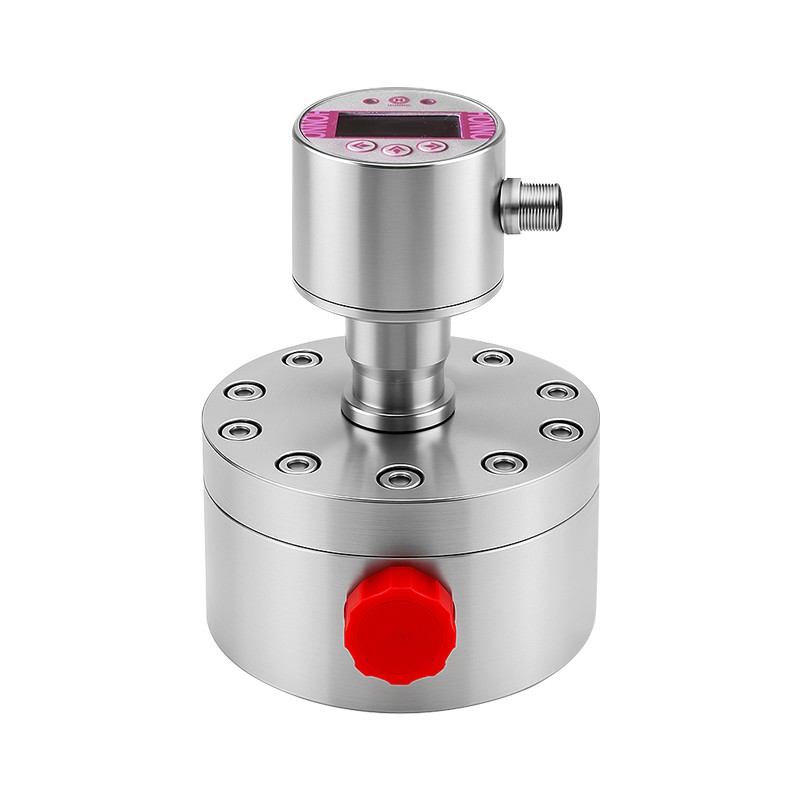
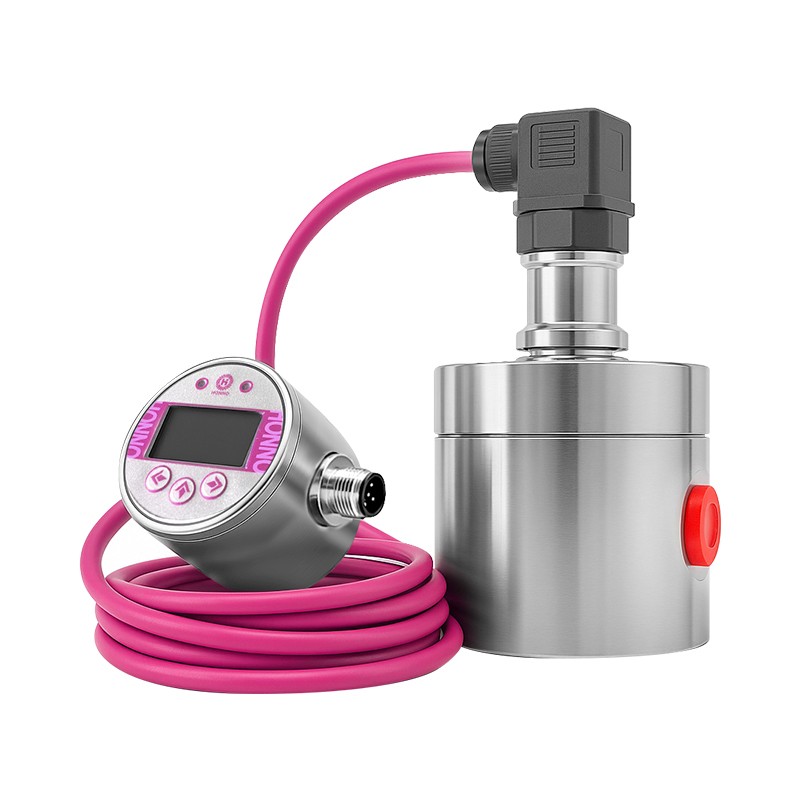
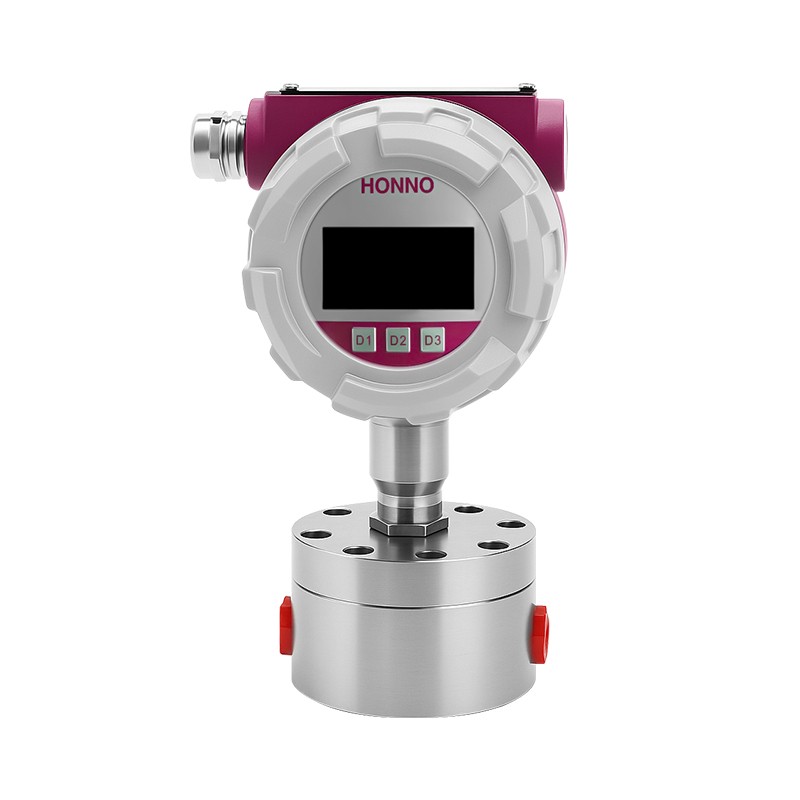
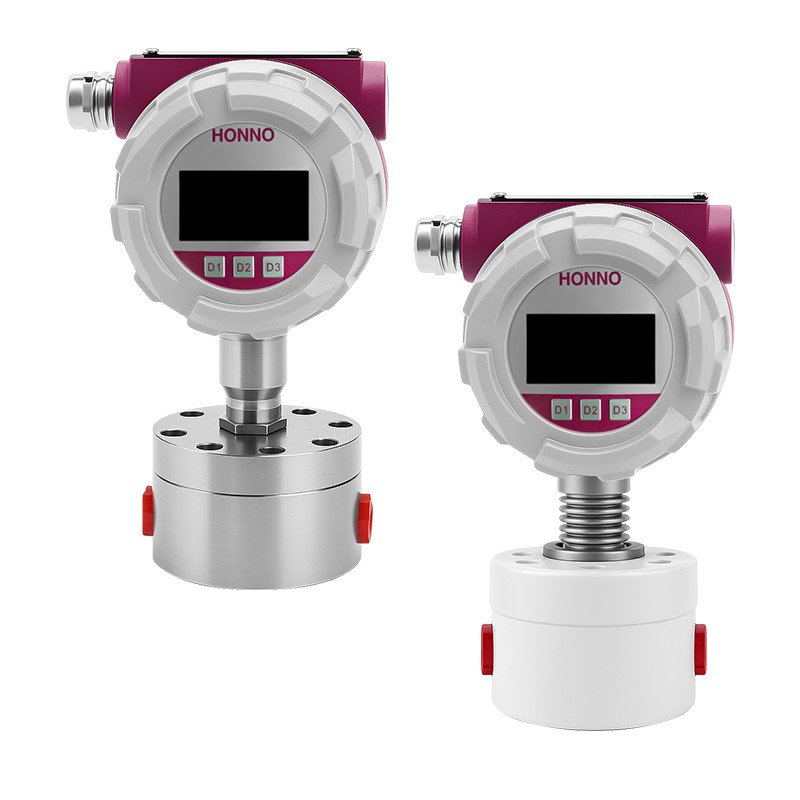
Positive displacement gear flow meter for viscous and corrosive liquids. 0.6–20,000 L/h, ±0.5% reading, to 400 bar, 200 ℃ option, Ex d IIC T6.
The HNF30 gear flow meter — also called a positive displacement (PD) or volumetric flow meter — is one of the most accurate ways to measure liquid. The medium enters the measuring chamber, and the pressure difference between inlet and outlet drives a pair of precisely meshed gears. Each gear tooth root forms an equal-volume chamber with the chamber wall, so every rotation divides the liquid into known-volume parts (V = N × ν), like scooping water with a ladle. A non-contact sensor generates one pulse per gear tooth and a signal amplifier digitises it into a square-wave output any PLC or counter can process; flow can be shown locally for instantaneous and totalised values, or transmitted wirelessly by GPRS.
Seven sizes cover 0.6–20,000 L/h for highly viscous media such as molasses, asphalt, honey and syrup, and for highly corrosive liquids such as sulphuric and hydrofluoric acid. It suits fuel consumption and brake-system test benches, engine coolant and steering systems, oil, brake fluid and antifreeze dosing and filling, hydraulic and chemical quantitative filling, A/B two-component ratio monitoring, leakage monitoring, ink and refrigerant R134a charging, reaction-kettle dropwise addition, pump verification and food/pharmaceutical viscous filling.
Good fit: automotive fuel consumption, brake system test bench, engine coolant, paint spraying, steering, oil/brake fluid/antifreeze dosing and filling, hydraulic industry, chemical dosing and filling, A/B two-component ratio, leakage monitoring, high-viscosity products (molasses, asphalt, honey, syrup, ink), R134a charging, hydrofluoric and sulphuric acid dosing, reactor dropwise addition, pump verification, food and pharmaceutical viscous filling.
Choose HNF30 when:
You measure viscous or corrosive liquids where turbine or vortex meters are limited, and low-flow accuracy and repeatability matter.
Precision dosing, ratio monitoring or batch filling needs a pulse, analog or RS485 signal to a PLC, counter or DCS.
The liquid viscosity lies in 5–500 mm²/s and a positive-displacement, no-straight-pipe installation is preferred.
Confirm with us first when: the medium viscosity is outside 5–500 mm²/s, solids content is high (filter size must match), the process pressure or temperature exceeds the standard rating, or a sanitary, flange or card-sleeve connection is required.
Two precisely matched gears are enclosed in a precision-machined chamber; the tooth root of each gear forms an equal-volume chamber with the measuring chamber wall. Gear rotation divides the liquid into individual known standard-volume parts, and total volume is measured from how many times the chambers are filled and discharged in sequence. If the circulating volume is ν and the number of gear rotations in a period is N, the volume V flowing through per unit time is V = N·ν. Non-contact sensors sense each gear and generate a pulse; the amplifier digitises the signal into a square wave for PLC or IC processing, and a local display shows instantaneous and cumulative flow. GPRS or other wireless display forms are available.
| Model | HNF30 — Gear (positive displacement / volumetric) flow meter |
|---|---|
| Measurement medium | Liquid |
| Execution standard | JB/T 9242-2015 General Technical Conditions for Liquid Volumetric Flowmeters |
| Medium viscosity | 5–500 mm²/s |
| Medium temperature | −40…80 ℃; high-temperature type to 200 ℃ (custom); low-temperature versions down to −196 ℃ on request |
| Ambient temperature | −40…85 ℃ |
| Pressure rating | Aluminium body 50 bar; stainless-steel body 100 bar; high-pressure version custom up to 400 bar |
| Accuracy | ±0.5 % of reading within a 1:20 range; ±1 % of reading over the full range (rated on a 20 cSt liquid) |
| Repeatability | ±0.1 % of reading |
| Range ratio / resolution | 1:150 range ratio; 10–16 P/rpm resolution |
| Supply voltage | 9–26 VDC |
| Explosion protection | Ex d IIC T6 Gb |
| Protection class | IP65 |
| Output signal | Analog 4–20 mA, 1–5 V, 2–10 V; pulse / frequency up to 5 kHz max |
| Communication | RS485 standard Modbus RTU; HART; GPRS; Bluetooth options |
| Electrical interface | M20×1.5 with metal explosion-proof gland |
| Body material | 1.4305 (304SS), 1.4144 (316L) or aluminium |
| Gear material | 304SS, 316L or high-hardness alloy steel |
| Bearing / seal | Rolling or sliding bearings; FKM, NBR or PTFE seals |
| Connections | Internal/external thread, Ermeto (bite-type) joint, sanitary chuck; flanges to GB/T 9112 and HG/T 20592-2010, ANSI/JIS versions available |
| Model | Range (L/h) | K factor (P/L) | Interface | Filter, rolling / sliding bearing (μm) |
|---|---|---|---|---|
| HNF30-02 | 0.6–50 | 11,200 | G1/4 | 20 / 40 |
| HNF30-04 | 5–250 | 4,780 | G3/8 | 20 / 40 |
| HNF30-06 | 10–500 | 3,468 | G1/2 | 20 / 40 |
| HNF30-10 | 20–1,200 | 2,780 | G1/2 | 20 / 40 |
| HNF30-15 | 200–3,000 | 334 | G3/4 | 20 / 150 |
| HNF30-25 | 1,000–12,000 | 110 | G1 | 100 / 150 |
| HNF30-32/40 | 2,000–20,000 | 40 | G1-1/4 | 100 / 150 |
A 20–150 μm filter is recommended depending on size and bearing type; finer filtration protects rolling bearings.
| Code segment | Code | Description |
|---|---|---|
| Flow range (L/h) | 02 | 0.6–50 |
| 04 | 5–250 | |
| 06 | 10–500 | |
| 10 | 20–1,200 | |
| 15 | 200–3,000 | |
| 25 | 1,000–12,000 | |
| 32 | 2,000–20,000 | |
| X | Customizable | |
| Seal | G | FKM |
| F | NBR | |
| K | PTFE | |
| Connection | 1 | Threaded connection |
| 2 | Flange connection | |
| 3 | Sanitary flange | |
| 4 | Card sleeve (Ermeto) joint | |
| Signal output | P | Pulse output |
| M | 4–20 mA | |
| R | RS485 | |
| Body material | 1 | Stainless steel |
| 2 | Aluminium alloy | |
| 3 | PTFE | |
| Special requirements | P | High pressure |
| T | High temperature | |
| Special requests | Y / N | Yes / No |
Standard body dimensions A–H vary by size (02 to 32/40); special dimensions can be customized to on-site requirements.
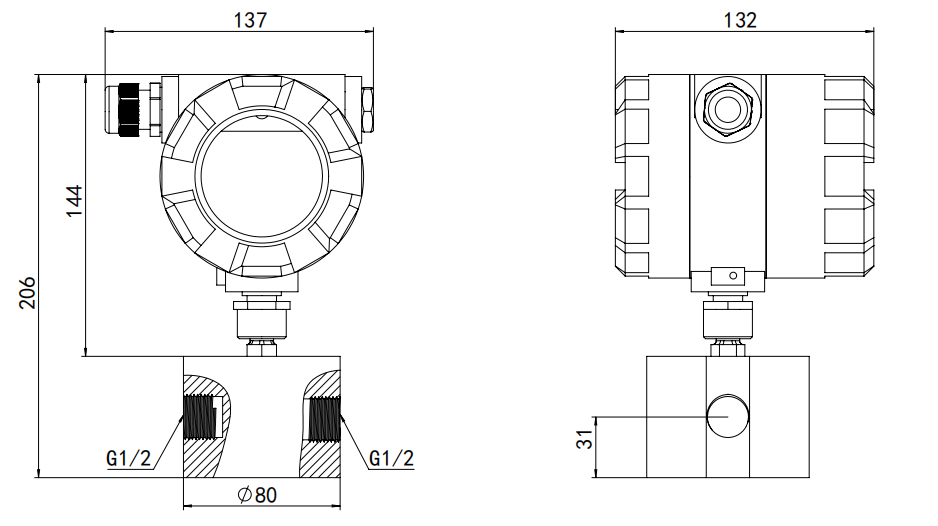
Positive-displacement measurement does not require long straight pipe runs, but keep the meter free of air entrainment and large solids.
Install a strainer/filter upstream; choose 20–150 μm according to size and bearing type, finer for rolling bearings.
Match body, gear and seal materials to the medium — PTFE seal and 316L/PTFE wetted parts for corrosive service.
Verify the K factor against the actual liquid viscosity; accuracy figures are rated on a 20 cSt liquid.
Automotive: fuel consumption, brake-system test bench, new-energy engine coolant, paint spraying, steering, engine oil / brake fluid / antifreeze / anti-corrosion fluid filling.
Hydraulic industry: quantitative filling, volume and velocity measurement, leakage monitoring, A/B two-component ratio monitoring.
Chemical industry: hydrofluoric acid and highly corrosive chemical metering, reactor dropwise addition.
High-viscosity products: asphalt, ink, honey, syrup; refrigerant R134a charging; verification of peristaltic, diaphragm and centrifugal pumps; food and pharmaceutical viscous filling.
Send: liquid name and viscosity, expected flow range, process pressure and temperature, required connection, output type, body/gear/seal materials, whether high-pressure or high-temperature service, and any sanitary or flange standard. We will confirm the size and selection code before quoting.
Can it measure both viscous and corrosive liquids?
Yes. The gear meter handles high-viscosity media such as molasses, asphalt, honey and syrup, and corrosive liquids such as sulphuric and hydrofluoric acid when 316L/PTFE wetted parts and PTFE seals are selected.
What flow range do the seven sizes cover?
Seven sizes cover 0.6–20,000 L/h, with K factors from 11,200 down to 40 P/L; a custom size (code X) is available outside this range.
Does each gear tooth generate one pulse?
A non-contact sensor generates one pulse per gear tooth; the amplifier digitises it into a square-wave pulse or frequency signal (max 5 kHz) for PLC, counter or local display processing.
How accurate is the meter within its specified 1:20 operating range?
Accuracy is ±0.5 % of reading within the 1:20 range and ±1 % of reading over the full range, with ±0.1 % repeatability; figures are rated on a 20 cSt liquid, so confirm against your actual viscosity.
Which body, gear and seal materials suit hydrofluoric acid service?
For HF and other aggressive service choose 316L or PTFE body/gear construction with PTFE seal (code K); send the chemical and concentration so we can confirm the material combination.
HNF30 Gear Flow Meter Datasheet (PDF) — view all product manuals on our Download page »
Send us the liquid, viscosity, flow range and pressure. We will confirm the size and selection code before we quote.
Send us your application details »
Contact: HongNuo
Phone: 13840589744
Tel: 86-13840589744
Email: Guiyang.bai@honno-auto. com
Add: Zhongguancun Innovation Center, No. 28 Huahai Road, Shenyang Economic and Technological Development Zone, Liaoning Province
We chat