
Guiyang.bai@honno-auto. com
86-13840589744
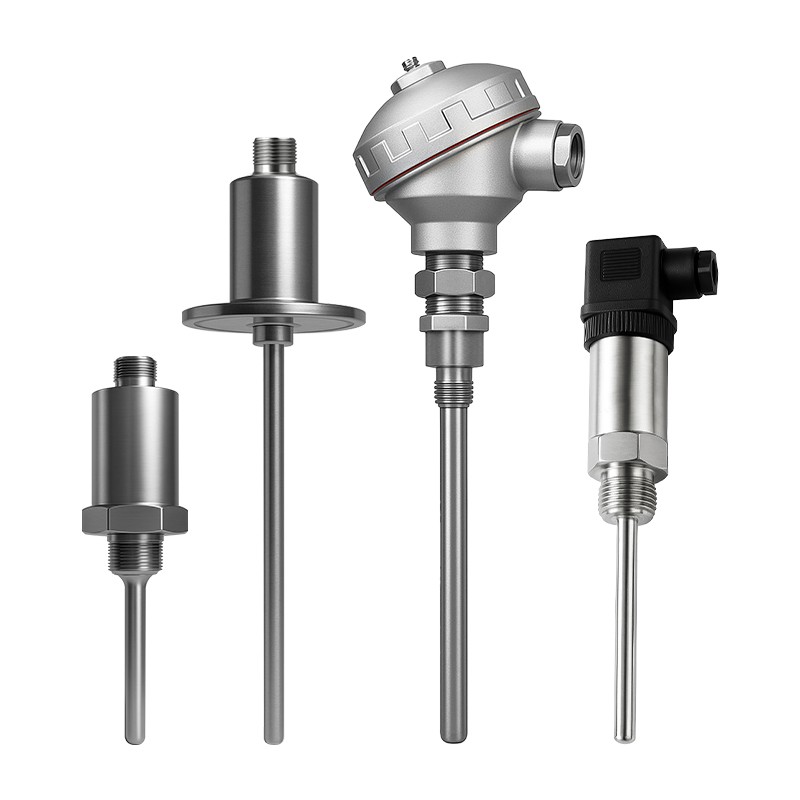
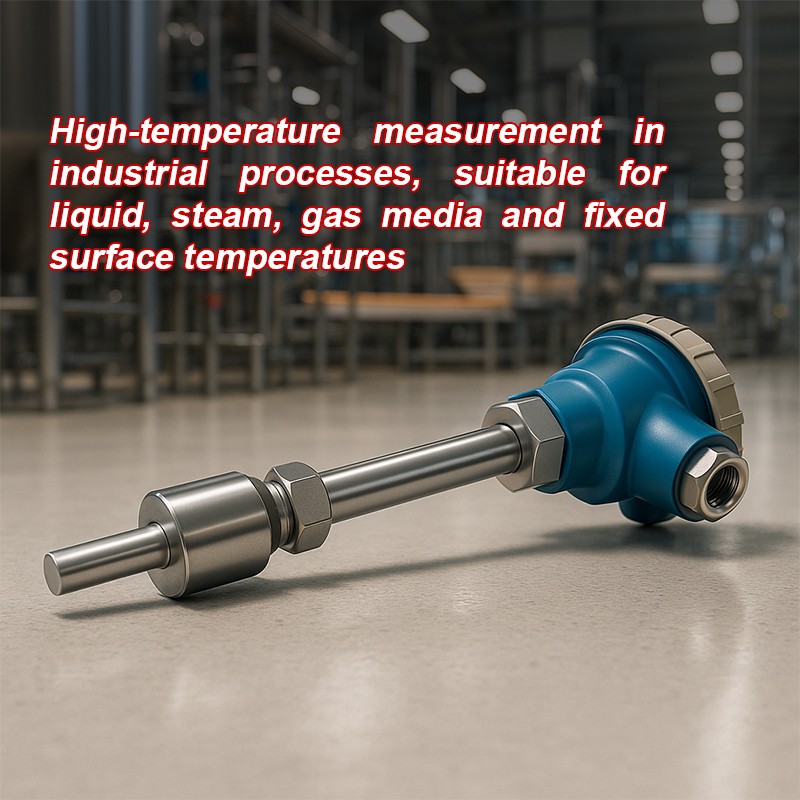
Armored thermocouple temperature sensor, types B/S/R/K/E/T/J up to 1800°C, stainless, alloy, alumina or corundum protective tube, threaded or flange mounting, optional 4-20mA transmitter and Ex d/Ex ia head, for boilers, furnaces, metallurgy and high-temperature process duty.
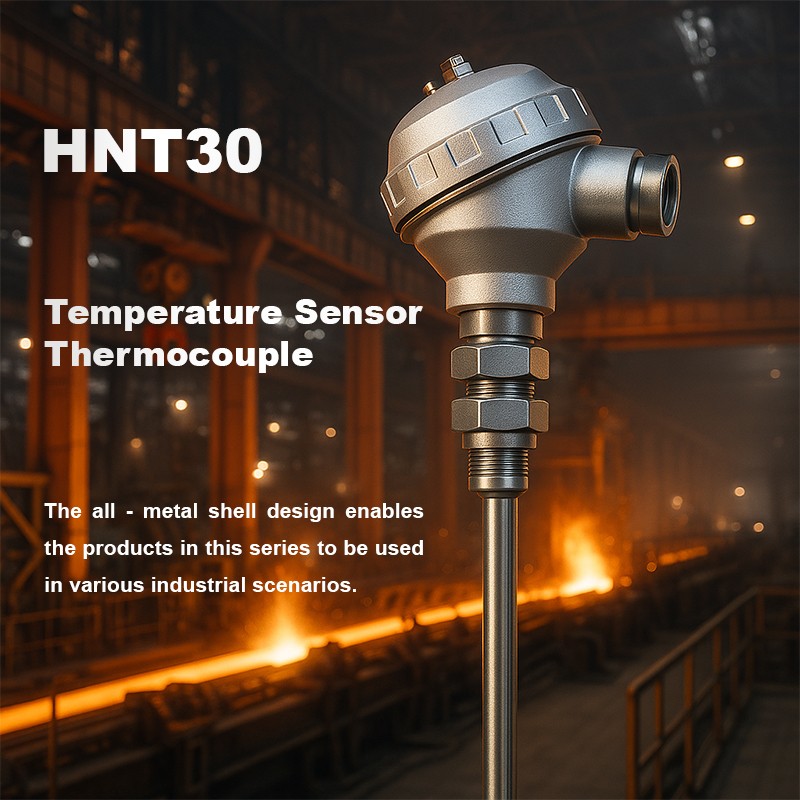
The HNT30 is an armored (sheathed) thermocouple temperature sensor built for high-temperature industrial measurement. It uses thermocouple wires or a Pt100 resistance element inside a metal or ceramic protective sleeve; the signal is conditioned by a post-processing circuit and converted to a standard industrial electrical output, with a 4–20 mA transmitter optional and HART available on request. The all-metal shell, threaded or flange mounting and selectable protective-tube material cover service from cryogenic lines to 1800 °C furnace and kiln duty.
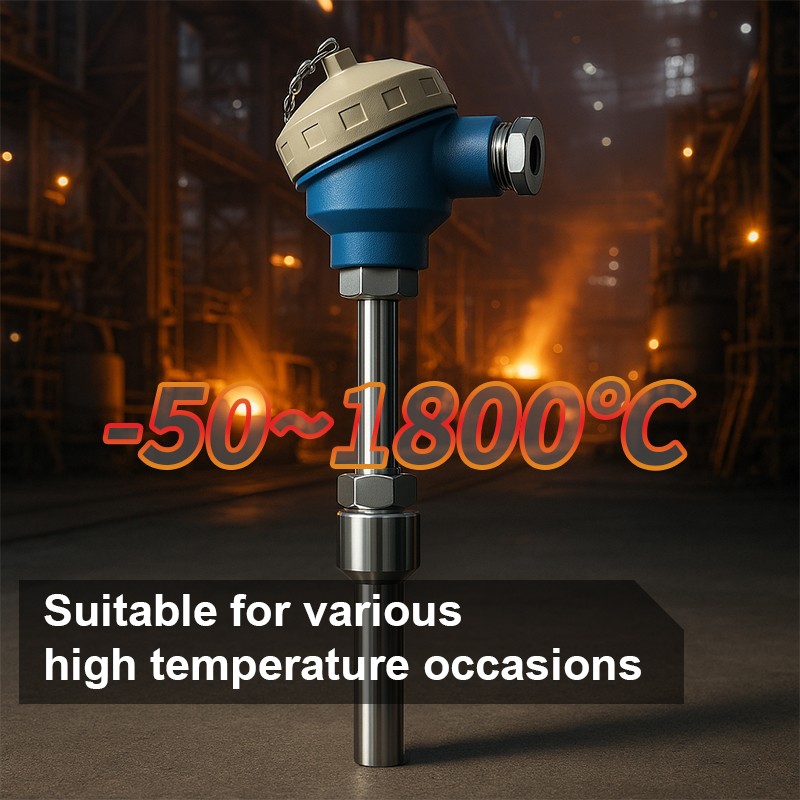
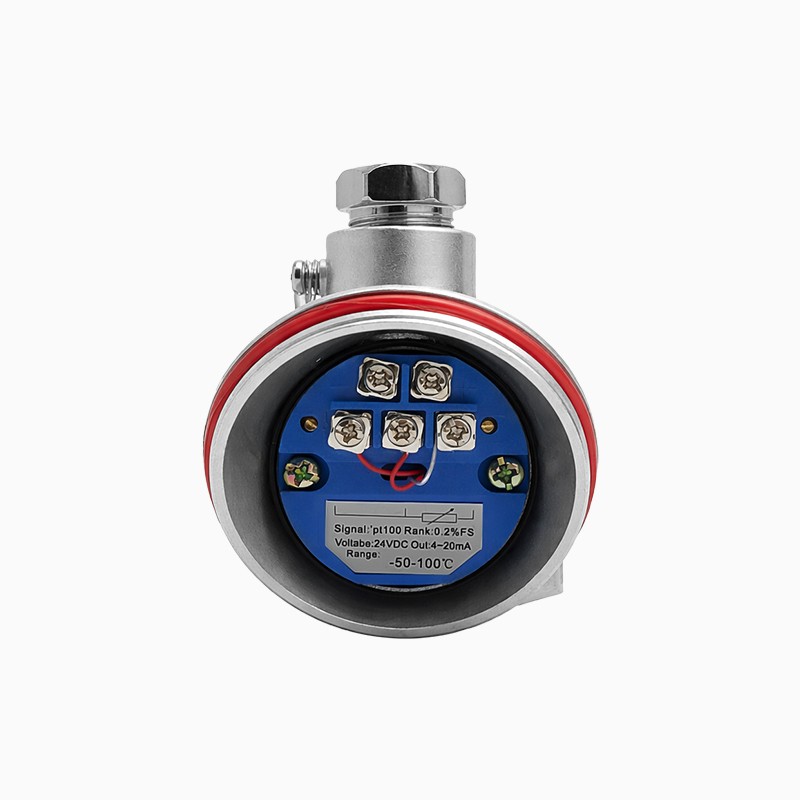
Resistance Pt100 sensors top out around 500 °C. The HNT30 crosses that line: thermocouple types B, S, R, K, E, T and J cover 0…1800 °C, and the protective tube can be 321 / 310 / 304 / 316 stainless steel, GH3030 alloy, high alumina or corundum to match the furnace temperature and medium. A terminal junction box on top keeps wiring safe in field-mounted, long-cable-run installations, and flange or threaded fittings suit boilers, main steam lines, kilns, furnaces and high-temperature reactors.
Good fit: thermal-power main steam pipelines, boiler and superheater measurement, industrial furnaces and kilns, cement and glass kilns, steel and metallurgy reheating, incinerators and flue-gas ducts, heat-treatment equipment, high-temperature process reactors, chemical high-temperature service, harsh-environment industrial measurement.
Choose HNT30 when:
Process temperature reaches above the Pt100 range — from 350 °C up to 1800 °C, with the correct thermocouple type and tube material selected for the top temperature.
The installation needs a threaded or flange fitting and a field-wireable junction box, rather than a compact plug-style sensor.
The medium is high-temperature gas, steam, flue gas, solid surface or non-aggressive high-temperature liquid; corrosive duties should be checked separately for tube material.
You need a raw thermocouple / Pt100 signal, an optional 4–20 mA transmitter, or HART output to a remote control system.
The area is a hazardous location where an Ex d or Ex ia explosion-proof head is required.
Confirm with us first when: the duty is below ~350 °C on clean water/oil/gas (HNT10 or HNT20 Pt100 is usually the cheaper choice), the medium is strongly corrosive (check HNT60 PFA/PTFE), you need a bus-based smart transmitter with HART / Modbus (HNT40), or the probe must be non-contact infrared (HNT50).
Type B (PtRh30-PtRh6) reaches 1800 °C; S and R (platinum-rhodium) reach 1600 °C; K (NiCr-NiSi) reaches 1300 °C; E, J and T cover lower industrial ranges. Choosing the right type avoids paying for platinum rhodium where K is enough, and avoids overheating a cheap type where S or B is required.
321 / 310 / 304 / 316 stainless handles steam, oil and gas up to roughly 1000 °C; GH3030 alloy resists 1100 °C; high alumina to 1300 °C; corundum to 1800 °C. The tube diameter and material also set the response time τ0.5 — thin metal tubes respond in under 90 s, ceramic tubes take longer but survive furnace heat.
Available Ex d IIB / IIC T1–T6 and Ex ia IIB / IIC T1–T6 heads for classified high-temperature process areas, in addition to the standard IP65 housing, with IP67 optional.
Order without a transmitter (code P) for direct connection to a thermocouple / RTD input card, or with a 4–20 mA transmitter (code M) for standard analog loops; HART output is available on request.
| Model | HNT30 — Armored thermocouple / RTD temperature sensor |
|---|---|
| Sensing element | Thermocouple types B, S, R, K, E, T, J; or Pt100 resistance element (0…600 °C). Single or dual element. |
| Thermocouple ranges and accuracy | B (PtRh30-PtRh6) 0…1800 °C, ±1.5 °C or ±0.25% t S (PtRh10-Pt) 0…1600 °C, ±1.5 °C or ±0.25% t R (PtRh13-Pt) 0…1600 °C, ±1.5 °C or ±0.25% t K (NiCr-NiSi) 0…1300 °C, ±2.5 °C or ±0.75% t E (NiCr-CuNi) 0…800 °C, ±2.5 °C or ±0.75% t J (Fe-CuNi) 0…750 °C, ±2.5 °C or ±0.75% t T (Cu-CuNi) 0…350 °C, ±1 °C or ±0.75% t |
| Accuracy class | Level I or Level II |
| Protective tube diameter | Ø6, Ø8, Ø16, Ø22, Ø25 mm; other diameters custom |
| Protective tube material | 321 stainless (X6CrNiTi1811), 310 stainless (X6CrNi2520, to 1000 °C), 304, 316, GH3030 alloy (1100 °C), high alumina (1300 °C), corundum (1800 °C); custom available |
| Thermal response τ0.5 | Depends on tube material and diameter: jadeite Ø16 <150 s, Ø25 <360 s; high alumina Ø16 <150 s, Ø20 <240 s, Ø25 <360 s; 321 / 310 stainless Ø16 <90 s |
| Max working pressure | < 10 MPa (affected by tube material, diameter and wall thickness) |
| Minimum insertion depth | > 8 × tube outer diameter (D) |
| Insulation resistance | ≥ 100 MΩ (tube <1000 mm); ≥ 100 MΩ·m above 1000 mm, tested at 500 V ± 50 VDC, 15–35 °C, 45–75 % RH |
| Output signal | Raw thermocouple / Pt100 signal (code P), or 4–20 mA transmitter output (code M); HART output optional on request |
| Electrical connection | M12×1.5, M16×1.5, M27×2, G1/2, G3/4 or 1/2 NPT; 2-wire |
| Mechanical connection | Threaded: G1/2, M20×1.5, NPT1/4; flanged: fixed flange FG50 or sliding flange FA50 |
| Protection rating | IP65 standard; IP67 optional |
| Explosion-proof (optional) | Ex d IIB T1–T6, Ex d IIC T1–T6, Ex ia IIB T1–T6, Ex ia IIC T1–T6 |
| Special options | S shock-resistant, W wear-resistant, C corrosion-resistant |
| Ordering code example | HNT30 – K2 / 0–800 °C / 500/300 / 016 / G / 316 / P / 0 / S |
Build the order code from left to right. Send us the full code — or just your application parameters and we will assemble it for you.
| Code segment | Code | Description |
|---|---|---|
| Temperature measurement type | P | Pt100 thermal resistor, 0…600 °C, single / dual element |
| K1 | K-type thermocouple, 0…600 °C, single / dual | |
| K2 | K-type thermocouple, 0…1200 °C, single / dual | |
| S | S-type thermocouple, 0…1600 °C, single / dual | |
| B | B-type thermocouple, 0…1600 °C, single / dual | |
| Temperature range | X | Write the required range directly, e.g. 0…1000 °C |
| Rod length | X | Total length / insertion depth in mm, e.g. 500/300 |
| Rod diameter | 060 | Ø6 mm protective tube |
| 080 | Ø8 mm protective tube | |
| 016 | Ø16 mm protective tube | |
| 020 | Ø22 mm protective tube | |
| 025 | Ø25 mm protective tube | |
| X | Custom diameter | |
| Mechanical connection | G | G1/2 thread |
| M | M20×1.5 thread | |
| N | NPT1/4 thread | |
| FG | 50 mm fixed flange | |
| FA | 50 mm sliding flange | |
| Rod material | 321 | 321 stainless steel |
| 310 | 310 stainless steel | |
| 304 | 304 stainless steel | |
| 316 | 316 stainless steel | |
| GH | GH3030 alloy, heat resistance 1100 °C | |
| HA | High alumina, heat resistance 1300 °C | |
| CO | Corundum, heat resistance 1800 °C | |
| X | Custom material | |
| Transmitter output | P | Without transmitter output |
| M | With 4–20 mA transmitter output | |
| Explosion-proof | 0 | No explosion-proof required |
| 1 | With explosion-proof head | |
| Special options | S | Shock-resistant |
| W | Wear-resistant | |
| C | Corrosion-resistant |
HNT30 is supplied in non-fixed, fixed-thread, fixed-flange and sliding-flange configurations, with single or dual elements and several total-length / insertion-depth combinations per diameter. Insert the structural dimension drawing below
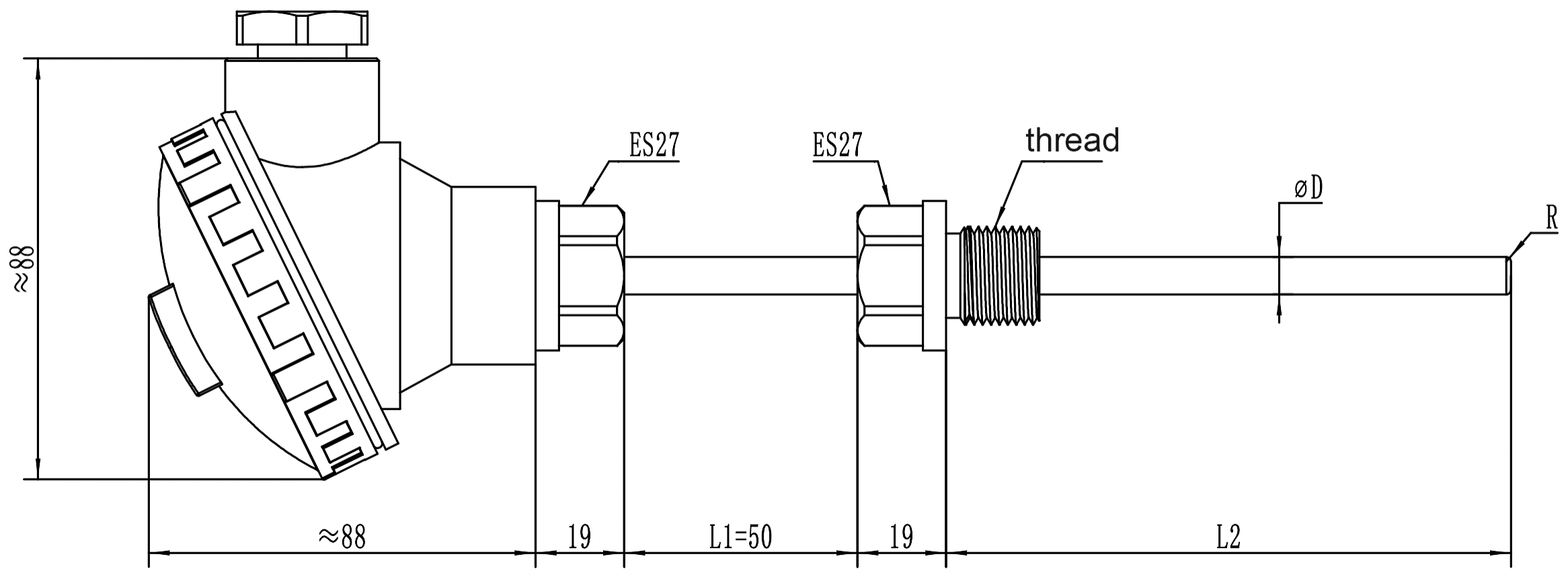
Installation and Configuration
Confirm these items before ordering:
Top process temperature and thermocouple type — B/S/R/K/E/T/J matched to the 1800 / 1600 / 1300 / 800 °C ceiling.
Protective tube material and diameter — stainless / alloy / alumina / corundum matched to temperature and medium; Ø6–Ø25.
Total length and insertion depth — insertion must exceed 8× tube diameter; state L/l in mm.
Fitting and output — thread or flange; raw signal or 4–20 mA transmitter; Ex d / Ex ia required or not.
Mount the probe so the tip sits in the active temperature zone of the pipe, duct or furnace — not against the wall and not short of the hot zone. Tighten on the hex fitting, never on the tube. For ceramic tubes, protect against mechanical shock during installation and operation. For Ex-rated heads, verify the cable gland, sealing and temperature group (T1–T6) match the hazardous-area classification.
Raw thermocouple / Pt100 (P): connect directly to a thermocouple or RTD input card on the DCS / PLC; use the correct compensation wiring for thermocouples.
4–20 mA transmitter (M): two-wire analog loop, standard 12…30 VDC supply, for ordinary analog input cards without a thermocouple channel.
HART (optional): HART output available on request for remote configuration and diagnostics to the control system.
For OEM / engineering / project enquiries, send us: medium, top and normal temperature, required fitting, insertion depth, output type, whether explosion-proof is required, and any vibration / abrasion / corrosion conditions. We will confirm the thermocouple type, tube material and final order code before quotation.
Main steam, superheater and economizer temperature points on thermal-power and process boilers, where K or S elements and stainless tubes survive steam and vibration.
Heat-treatment furnaces, brick and cement kilns, glass-melting and ceramic kilns; S or B elements in alumina or corundum tubes for 1300…1800 °C hot zones.
Reheating furnaces, soaking pits and quench tanks in rolling mills, with wear-resistant or shock-resistant constructions where scale and vibration are present.
Waste-incineration flue-gas, chimney and duct temperature monitoring, with corrosion-resistant tubes where acid condensation occurs.
Chemical reactors, calcination and drying equipment, and high-temperature process lines where Pt100 sensors cannot reach the operating temperature.
Send the following with your enquiry: process medium, maximum and normal operating temperature, required thermocouple type (if known), available fitting or flange size, total length and insertion depth, output required (raw signal or 4–20 mA), explosion-proof class if any, and conditions such as vibration, abrasion or corrosive gas. For furnace and kiln duties, note the hot-zone temperature and whether the probe sees direct flame or radiant heat.
Which thermocouple type reaches 1800 °C?
Type B (PtRh30-PtRh6) covers 0…1800 °C. Type S and R reach 1600 °C; K reaches 1300 °C. The 1800 °C service also requires a corundum protective tube, not stainless steel.
How do Type K and Type S differ at high temperature?
K (NiCr-NiSi) is a base-metal thermocouple, lower cost, good for 0…1300 °C. S (PtRh10-Pt) and R are platinum-rhodium, more accurate at 1300…1600 °C but more expensive. B-type platinum-rhodium covers up to 1800 °C for furnace duty.
What protection tube gives the fastest response near furnace temperature?
Thin stainless tubes respond fastest (Ø16, <90 s), but only up to their temperature limit. Above that, high alumina or corundum tubes survive the heat but have longer τ0.5 (150–360 s) because the wall and ceramic are thicker.
Can HART transmit thermocouple readings to a remote control system?
Yes — HART output is optional on the HNT30. Order the 4–20 mA transmitter and request HART; otherwise the sensor ships with a raw thermocouple or 4–20 mA signal only.
Are explosion-proof heads available for hazardous high-temperature areas?
Yes. Optional Ex d IIB / IIC and Ex ia IIB / IIC heads, temperature groups T1–T6. Tell us the zone classification, gas group and T-group so we confirm the correct rating.
Send us the medium, top temperature, fitting, insertion depth and required output. We will confirm the thermocouple type, tube material and whether an Ex head is needed before we quote.
Send us your application details »
Contact: HongNuo
Phone: 13840589744
Tel: 86-13840589744
Email: Guiyang.bai@honno-auto. com
Add: Zhongguancun Innovation Center, No. 28 Huahai Road, Shenyang Economic and Technological Development Zone, Liaoning Province
We chat